Skip to main content
Contents Index
Search Book
Search Results:
No results.
Readability settings Prev Up Next Scratch ActiveCode Profile title here \(\newcommand{\markedPivot}[1]{\boxed{#1}}
\newcommand{\IR}{\mathbb{R}}
\newcommand{\IC}{\mathbb{C}}
\renewcommand{\P}{\mathcal{P}}
\renewcommand{\Im}{\operatorname{Im}}
\newcommand{\RREF}{\operatorname{RREF}}
\newcommand{\vspan}{\operatorname{span}}
\newcommand{\setList}[1]{\left\{#1\right\}}
\newcommand{\setBuilder}[2]{\left\{#1\,\middle|\,#2\right\}}
\newcommand{\unknown}{\,{\color{gray}?}\,}
\newcommand{\drawtruss}[2][1]{
\begin{tikzpicture}[scale=#1, every node/.style={scale=#1}]
\draw (0,0) node[left,magenta]{C} --
(1,1.71) node[left,magenta]{A} --
(2,0) node[above,magenta]{D} -- cycle;
\draw (2,0) --
(3,1.71) node[right,magenta]{B} --
(1,1.71) -- cycle;
\draw (3,1.71) -- (4,0) node[right,magenta]{E} -- (2,0) -- cycle;
\draw[blue] (0,0) -- (0.25,-0.425) -- (-0.25,-0.425) -- cycle;
\draw[blue] (4,0) -- (4.25,-0.425) -- (3.75,-0.425) -- cycle;
\draw[thick,red,->] (2,0) -- (2,-0.75);
#2
\end{tikzpicture}
}
\newcommand{\trussNormalForces}{
\draw [thick, blue,->] (0,0) -- (0.5,0.5);
\draw [thick, blue,->] (4,0) -- (3.5,0.5);
}
\newcommand{\trussCompletion}{
\trussNormalForces
\draw [thick, magenta,<->] (0.4,0.684) -- (0.6,1.026);
\draw [thick, magenta,<->] (3.4,1.026) -- (3.6,0.684);
\draw [thick, magenta,<->] (1.8,1.71) -- (2.2,1.71);
\draw [thick, magenta,->] (1.6,0.684) -- (1.5,0.855);
\draw [thick, magenta,<-] (1.5,0.855) -- (1.4,1.026);
\draw [thick, magenta,->] (2.4,0.684) -- (2.5,0.855);
\draw [thick, magenta,<-] (2.5,0.855) -- (2.6,1.026);
}
\newcommand{\trussCForces}{
\draw [thick, blue,->] (0,0) -- (0.5,0.5);
\draw [thick, magenta,->] (0,0) -- (0.4,0.684);
\draw [thick, magenta,->] (0,0) -- (0.5,0);
}
\newcommand{\trussStrutVariables}{
\node[above] at (2,1.71) {\(x_1\)};
\node[left] at (0.5,0.866) {\(x_2\)};
\node[left] at (1.5,0.866) {\(x_3\)};
\node[right] at (2.5,0.866) {\(x_4\)};
\node[right] at (3.5,0.866) {\(x_5\)};
\node[below] at (1,0) {\(x_6\)};
\node[below] at (3,0) {\(x_7\)};
}
\newcommand{\lt}{<}
\newcommand{\gt}{>}
\newcommand{\amp}{&}
\definecolor{fillinmathshade}{gray}{0.9}
\newcommand{\fillinmath}[1]{\mathchoice{\colorbox{fillinmathshade}{$\displaystyle \phantom{\,#1\,}$}}{\colorbox{fillinmathshade}{$\textstyle \phantom{\,#1\,}$}}{\colorbox{fillinmathshade}{$\scriptstyle \phantom{\,#1\,}$}}{\colorbox{fillinmathshade}{$\scriptscriptstyle\phantom{\,#1\,}$}}}
\)
Section 5.3 Eigenvalues and Characteristic Polynomials (GT3)
Learning Outcomes
Find the eigenvalues of a
\(2\times 2\) matrix.
Subsection 5.3.1 Warm Up
Activity 5.3.1 .
Let
\(R\colon\IR^2\to\IR^2\) be the transformation given by rotating vectors about the origin through and angle of
\(45^\circ\text{,}\) and let
\(S\colon\IR^2\to\IR^2\) denote the transformation that reflects vectors about the line
\(x_1=x_2\text{.}\)
(a) If
\(L\) is a line, let
\(R(L)\) denote the line obtained by applying
\(R\) to it. Are there any lines
\(L\) for which
\(R(L)\) is parallel to
\(L\text{?}\)
(b) Now consider the transformation
\(S\text{.}\) Are there any lines
\(L\) for which
\(S(L)\) is parallel to
\(L\text{?}\)
Subsection 5.3.2 Class Activities
Activity 5.3.2 .
An invertible matrix
\(M\) and its inverse
\(M^{-1}\) are given below:
\begin{equation*}
M=\left[\begin{array}{cc}1&2\\3&4\end{array}\right]
\hspace{2em}
M^{-1}=\left[\begin{array}{cc}-2&1\\3/2&-1/2\end{array}\right]
\end{equation*}
Which of the following is equal to
\(\det(M)\det(M^{-1})\text{?}\)
Fact 5.3.3 .
For every invertible matrix \(M\text{,}\)
\begin{equation*}
\det(M)\det(M^{-1})= \det(I)=1
\end{equation*}
so \(\det(M^{-1})=\frac{1}{\det(M)}\text{.}\)
Furthermore, a square matrix
\(M\) is invertible if and only if
\(\det(M)\not=0\text{.}\)
Definition 5.3.5 .
Let
\(A \in M_{n,n}\text{.}\) An
eigenvector for
\(A\) is a vector
\(\vec{x} \in \IR^n\) such that
\(A\vec{x}\) is parallel to
\(\vec{x}\text{.}\)
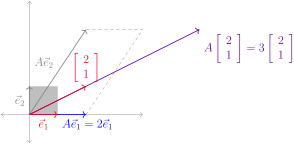
Figure 66. The map \(A\) stretches out the eigenvector \(\left[\begin{array}{c}2 \\ 1 \end{array}\right]\) by a factor of \(3\) (the corresponding eigenvalue).
In other words,
\(A\vec{x}=\lambda \vec{x}\) for some scalar
\(\lambda\text{.}\) If
\(\vec x\not=\vec 0\text{,}\) then we say
\(\vec x\) is a
nontrivial eigenvector and we call this
\(\lambda\) an
eigenvalue of
\(A\text{.}\)
Activity 5.3.6 .
Finding the eigenvalues \(\lambda\) that satisfy
\begin{equation*}
A\vec x=\lambda\vec x=\lambda(I\vec x)=(\lambda I)\vec x
\end{equation*}
for some nontrivial eigenvector \(\vec x\) is equivalent to finding nonzero solutions for the matrix equation
\begin{equation*}
(A-\lambda I)\vec x =\vec 0\text{.}
\end{equation*}
(a) If
\(\lambda\) is an eigenvalue, and
\(T\) is the transformation with standard matrix
\(A-\lambda I\text{,}\) which of these must contain a non-zero vector?
(b) Therefore, what can we conclude?
\(A-\lambda I\) is invertible
\(A-\lambda I\) is not invertible
(c)
\(\displaystyle \det A=0\)
\(\displaystyle \det A=1\)
\(\displaystyle \det(A-\lambda I)=0\)
\(\displaystyle \det(A-\lambda I)=1\)
Fact 5.3.7 .
The eigenvalues
\(\lambda\) for a matrix
\(A\) are exactly the values that make
\(A-\lambda I\) non-invertible.
Thus the eigenvalues \(\lambda\) for a matrix \(A\) are the solutions to the equation
\begin{equation*}
\det(A-\lambda I)=0.
\end{equation*}
Definition 5.3.8 .
The expression
\(\det(A-\lambda I)\) is called the
characteristic polynomial of
\(A\text{.}\)
For example, when \(A=\left[\begin{array}{cc}1 & 2 \\ 5 & 4\end{array}\right]\text{,}\) we have
\begin{equation*}
A-\lambda I=
\left[\begin{array}{cc}1 & 2 \\ 5 & 4\end{array}\right]-
\left[\begin{array}{cc}\lambda & 0 \\ 0 & \lambda\end{array}\right]=
\left[\begin{array}{cc}1-\lambda & 2 \\ 5 & 4-\lambda\end{array}\right]\text{.}
\end{equation*}
Thus the characteristic polynomial of \(A\) is
\begin{equation*}
\det\left[\begin{array}{cc}1-\lambda & 2 \\ 5 & 4-\lambda\end{array}\right]
=
(1-\lambda)(4-\lambda)-(2)(5)
=
\lambda^2-5\lambda-6
\end{equation*}
and its eigenvalues are the solutions \(-1,6\) to \(\lambda^2-5\lambda-6=0\text{.}\)
Activity 5.3.9 .
Let
\(A = \left[\begin{array}{cc} 5 & 2 \\ -3 & -2 \end{array}\right]\text{.}\)
(a) Compute
\(\det (A-\lambda I)\) to determine the characteristic polynomial of
\(A\text{.}\)
(b) Set this characteristic polynomial equal to zero and factor to determine the eigenvalues of
\(A\text{.}\)
Activity 5.3.10 .
Find all the eigenvalues for the matrix
\(A=\left[\begin{array}{cc} 3 & -3 \\ 2 & -4 \end{array}\right]\text{.}\)
Activity 5.3.11 .
Find all the eigenvalues for the matrix
\(A=\left[\begin{array}{cc} 1 & -4 \\ 0 & 5 \end{array}\right]\text{.}\)
Activity 5.3.12 .
Find all the eigenvalues for the matrix
\(A=\left[\begin{array}{ccc} 3 & -3 & 1 \\ 0 & -4 & 2 \\ 0 & 0 & 7 \end{array}\right]\text{.}\)
Subsection 5.3.3 Cool Down
Activity 5.3.13 .
Let
\(A\in M_{n,n}\) and
\(\lambda\in\IR\text{.}\) The eigenvalues of
\(A\) that correspond to
\(\lambda\) are the vectors that get stretched by a factor of
\(\lambda\text{.}\) Consider the following special cases for which we can make more geometric meaning.
(a) What are some other ways we can think of the eigenvalues corresponding to eigenvalue
\(\lambda=0\text{?}\)
(b) What are some other ways we can think of the eigenvalues corresponding to eigenvalue
\(\lambda=1\text{?}\)
(c) What are some other ways we can think of the eigenvalues corresponding to eigenvalue
\(\lambda=-1\text{?}\)
(d) How might we interpret a matrix that has no (real) eigenvectors/values?
Subsection 5.3.4 Videos
Figure 67. Video: Finding eigenvalues
Exercises 5.3.5 Exercises
Subsection 5.3.6 Mathematical Writing Explorations
Exploration 5.3.14 .
What are the maximum and minimum number of eigenvalues associated with an \(n \times n\) matrix? Write small examples to convince yourself you are correct, and then prove this in generality.
Subsection 5.3.7 Sample Problem and Solution
You have attempted
of
activities on this page.